
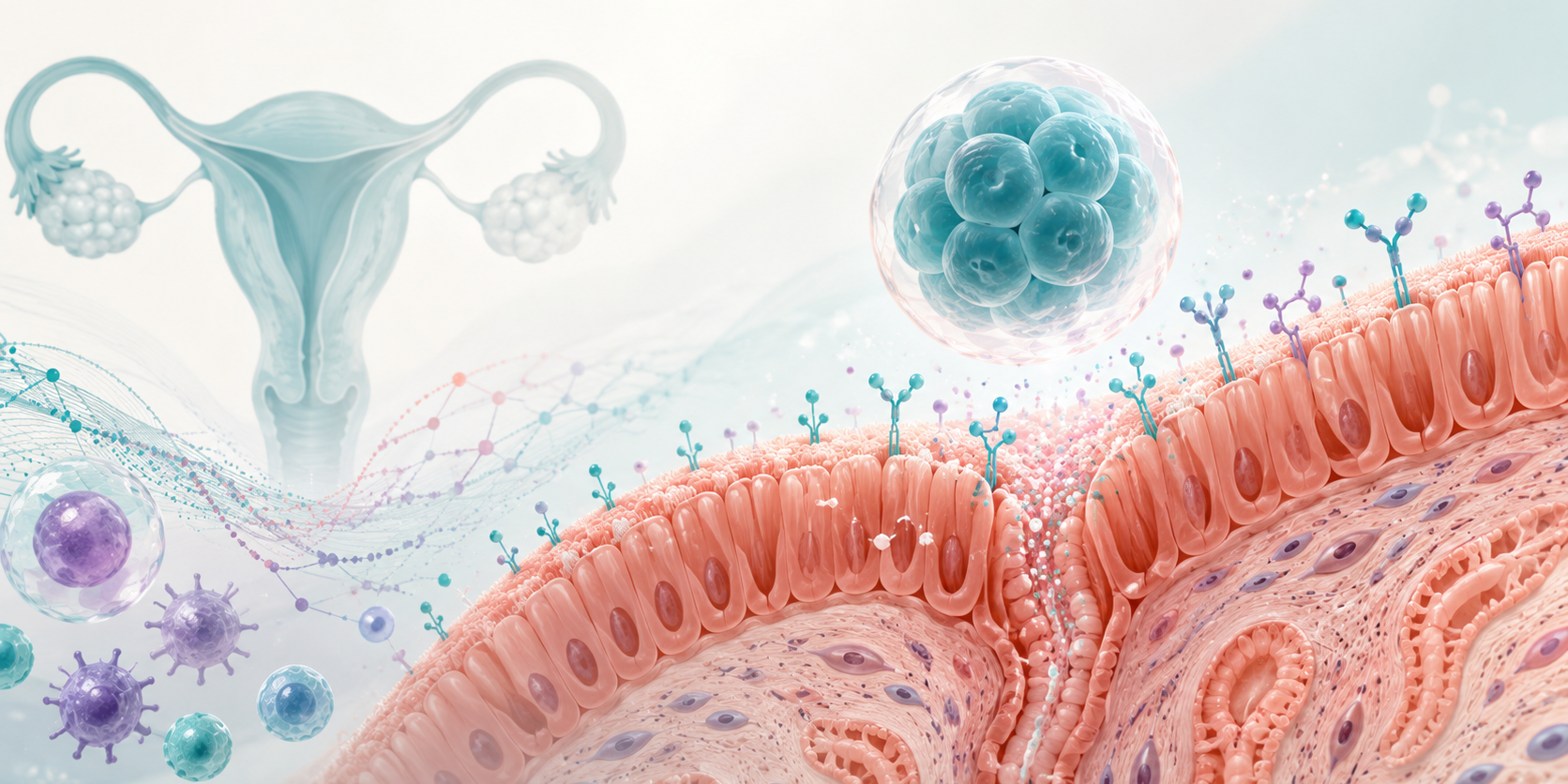
Endometrial receptivity refers to the ability of the endometrium, the inner lining of the uterus, to allow embryo implantation during a specific and limited period of the menstrual cycle. This receptive phase is known as the window of implantation.
In reproductive medicine, endometrial receptivity is a key concept because successful implantation depends not only on embryo quality, but also on the readiness of the endometrium to receive and support the embryo. When this synchronization is altered, implantation may be less likely to occur.
Understanding endometrial receptivity helps explain why embryo implantation is such a complex process and why some embryo transfers fail even when embryo quality appears favorable.
What is endometrial receptivity?
Endometrial receptivity is the state in which the endometrium becomes biologically prepared for embryo attachment, invasion and early placental development.
During most of the menstrual cycle, the endometrium is not receptive. It becomes receptive only after a coordinated sequence of hormonal, molecular, cellular and immune changes. These changes transform the endometrium into a tissue capable of interacting with the embryo.
This process is mainly regulated by estrogen and progesterone. Estrogen supports endometrial growth during the first part of the cycle, while progesterone promotes secretory transformation and prepares the tissue for implantation.
In simple terms, endometrial receptivity is the moment when the uterus is biologically ready for the embryo.
Why is endometrial receptivity important?
Embryo implantation requires a precise dialogue between the embryo and the endometrium. A competent embryo must reach the uterus at the right developmental stage, and the endometrium must be receptive at the same time.
If the embryo and the endometrium are not synchronized, implantation may fail. This is especially relevant in assisted reproduction, where embryo transfer timing is carefully planned.
Endometrial receptivity is important because it influences:
- embryo attachment
- implantation success
- early pregnancy establishment
- reproductive outcomes in IVF
- the interpretation of recurrent implantation failure
However, implantation failure is rarely explained by one factor alone. Embryo quality, uterine anatomy, hormonal environment, inflammation, microbiome composition and systemic factors may all contribute.
What is the window of implantation?
The window of implantation is the limited period during which the endometrium is receptive to embryo implantation.
In a natural menstrual cycle, this window usually occurs during the mid-secretory phase, several days after ovulation. In IVF or frozen embryo transfer cycles, the timing is often calculated according to progesterone exposure.
The window of implantation is not open throughout the cycle. Before this period, the endometrium may not be ready for embryo attachment. After this period, the endometrium may become less supportive of implantation.
This is why timing is so important in reproductive medicine. The embryo and the endometrium must meet at the right biological moment.
How does the endometrium become receptive?
Endometrial receptivity is the result of several coordinated changes.
At the tissue level, the endometrium becomes thicker, more vascularized and more secretory. Endometrial glands produce molecules that support embryo communication, while stromal cells undergo decidualization, a transformation that prepares the tissue for pregnancy.
At the molecular level, genes and proteins involved in adhesion, immune tolerance, inflammation control and tissue remodeling become active. Research has identified several molecular pathways associated with receptivity, including markers related to embryo adhesion, cytokine signaling and immune regulation.
At the immune level, the endometrium must create a balanced environment. It needs to tolerate the embryo while maintaining protection against infection and excessive inflammation.
At the microbiological level, emerging research suggests that the uterine and endometrial microbiome may also influence the local environment, although its clinical role is still being studied.
Hormonal regulation of endometrial receptivity
Hormones play a central role in preparing the endometrium.
Estrogen stimulates the proliferation of endometrial tissue during the first part of the cycle. After ovulation, progesterone becomes the dominant hormone and drives the secretory changes needed for implantation.
Progesterone exposure is especially important because it helps define the timing of the window of implantation. If progesterone exposure is insufficient, excessive or mistimed, the endometrium and embryo may become asynchronous.
In assisted reproduction, this is one reason why progesterone support and embryo transfer timing are carefully controlled.
Endometrial receptivity and embryo implantation
Implantation is not a passive event. It is an active biological process involving communication between the embryo and the endometrium.
The process includes three broad phases:
- Apposition, when the embryo comes into close contact with the endometrial surface.
- Adhesion, when the embryo attaches more firmly to the endometrial epithelium.
- Invasion, when embryonic cells begin to penetrate the endometrial tissue and initiate early placental development.
For these steps to occur, the endometrium must provide the right structural, hormonal, molecular and immune conditions.
A receptive endometrium does not guarantee pregnancy, but it is an essential requirement for implantation to occur.
What can affect endometrial receptivity?
Several factors may alter endometrial receptivity. Some are related to the uterus itself, while others reflect broader systemic or reproductive conditions.
Possible factors include:
- altered progesterone signaling
- thin or poorly developed endometrium
- chronic endometritis
- endometriosis
- adenomyosis
- uterine fibroids or polyps
- intrauterine adhesions
- hydrosalpinx
- inflammation
- metabolic or endocrine disorders
- changes in the endometrial microbiome
Not all of these factors affect every patient in the same way. Their clinical relevance depends on the individual context, including age, embryo quality, reproductive history and previous treatment outcomes.
Endometrial receptivity in IVF
In IVF, endometrial receptivity is especially important because embryo transfer can be planned with precision.
In fresh embryo transfer cycles, the endometrium develops under the influence of ovarian stimulation. In frozen embryo transfer cycles, the endometrium may be prepared through a natural, modified natural or hormone replacement protocol.
The goal is always the same: to transfer the embryo when the endometrium is most likely to be receptive.
If implantation does not occur after embryo transfer, clinicians may evaluate several aspects of the cycle, including embryo quality, uterine cavity, endometrial thickness, progesterone exposure and possible inflammatory or anatomical factors.
Can endometrial receptivity be tested?
Several commercial tests have been developed to assess endometrial receptivity, often by analyzing gene expression patterns in endometrial tissue. These tests aim to identify whether the window of implantation is displaced and whether embryo transfer timing should be personalized.
However, the routine use of endometrial receptivity testing remains debated. Current recommendations indicate that there is not enough evidence to recommend the routine use of commercially available endometrial receptivity tests for all patients with recurrent implantation failure, although assessment of specific aspects of endometrial function may be considered in selected cases.
This distinction is important. Endometrial receptivity is a biologically relevant concept, but not every available test has the same level of clinical evidence.
Endometrial receptivity and recurrent implantation failure
Recurrent implantation failure is a complex and controversial clinical scenario. It describes a situation in which embryos considered viable fail to result in pregnancy after repeated embryo transfers.
Endometrial receptivity may contribute to recurrent implantation failure in some cases, but it is not the only possible explanation. Embryonic factors, uterine abnormalities, chronic inflammation, hormonal issues, male factor and laboratory or transfer-related variables may also play a role.
ESHRE recommendations emphasize that recurrent implantation failure should be assessed carefully and that many tests and treatments require stronger evidence before being used routinely.
For this reason, endometrial receptivity should be evaluated as part of a broader clinical assessment rather than as an isolated explanation.
The role of the endometrial microbiome
The endometrial microbiome is an increasingly relevant area of research in reproductive medicine, particularly in relation to embryo implantation and early pregnancy.
Studies have identified associations between endometrial microbial profiles and reproductive outcomes. Some investigations have reported more favorable implantation and pregnancy outcomes in patients with Lactobacillus-enriched endometrial profiles, while certain other microbial patterns have been associated with unsuccessful outcomes.
These findings suggest that the endometrial microbial environment may be relevant to the biological processes involved in implantation. However, the mechanisms underlying these associations and their clinical implications are still being investigated.
Because the endometrium is a low-microbial-biomass environment, rigorous sampling procedures, contamination controls and appropriate analytical methods are particularly important when interpreting microbiome results.
Understanding these scientific and methodological considerations is essential for reproductive healthcare professionals evaluating emerging microbiome tests.
For professionals interested in exploring this field further, GenHERate IQ offers the online course Reproductive Microbiome: From Science to Personalized Practice, covering reproductive microbial communities, sequencing technologies, microbiome analysis and emerging clinical applications.
Can endometrial receptivity be improved?
Improving endometrial receptivity depends on identifying and addressing the underlying cause.
In some cases, clinical management may involve treating uterine abnormalities, correcting hormonal imbalances, managing chronic endometritis, optimizing progesterone exposure or adjusting embryo transfer timing.
Lifestyle and systemic health may also be relevant. Body weight, metabolic health, thyroid function and inflammatory conditions can influence reproductive outcomes.
However, there is no universal treatment to “improve receptivity” in every patient. The most appropriate approach should be individualized and based on evidence.
Why endometrial receptivity matters in reproductive medicine
Endometrial receptivity is one of the central concepts in reproductive medicine because it connects embryo biology with maternal physiology.
It helps explain why implantation requires more than a good-quality embryo. It also highlights the importance of the uterine environment, hormonal timing, immune balance and molecular communication.
For clinicians, embryologists and researchers, understanding endometrial receptivity is essential for interpreting implantation failure, improving embryo transfer strategies and advancing personalized reproductive care.
Key takeaways
Endometrial receptivity is the ability of the endometrium to support embryo implantation during a limited period known as the window of implantation.
This process depends on hormonal regulation, molecular signaling, immune balance, tissue remodeling and embryo-endometrium communication.
In IVF, receptivity is especially important because embryo transfer timing must be synchronized with the endometrial state. However, implantation outcomes depend on many factors, including embryo quality, uterine anatomy, inflammation, microbiome composition and systemic health.
Endometrial receptivity testing may be useful in selected contexts, but its routine use remains debated. The most effective approach is careful, individualized and evidence-based evaluation.
