
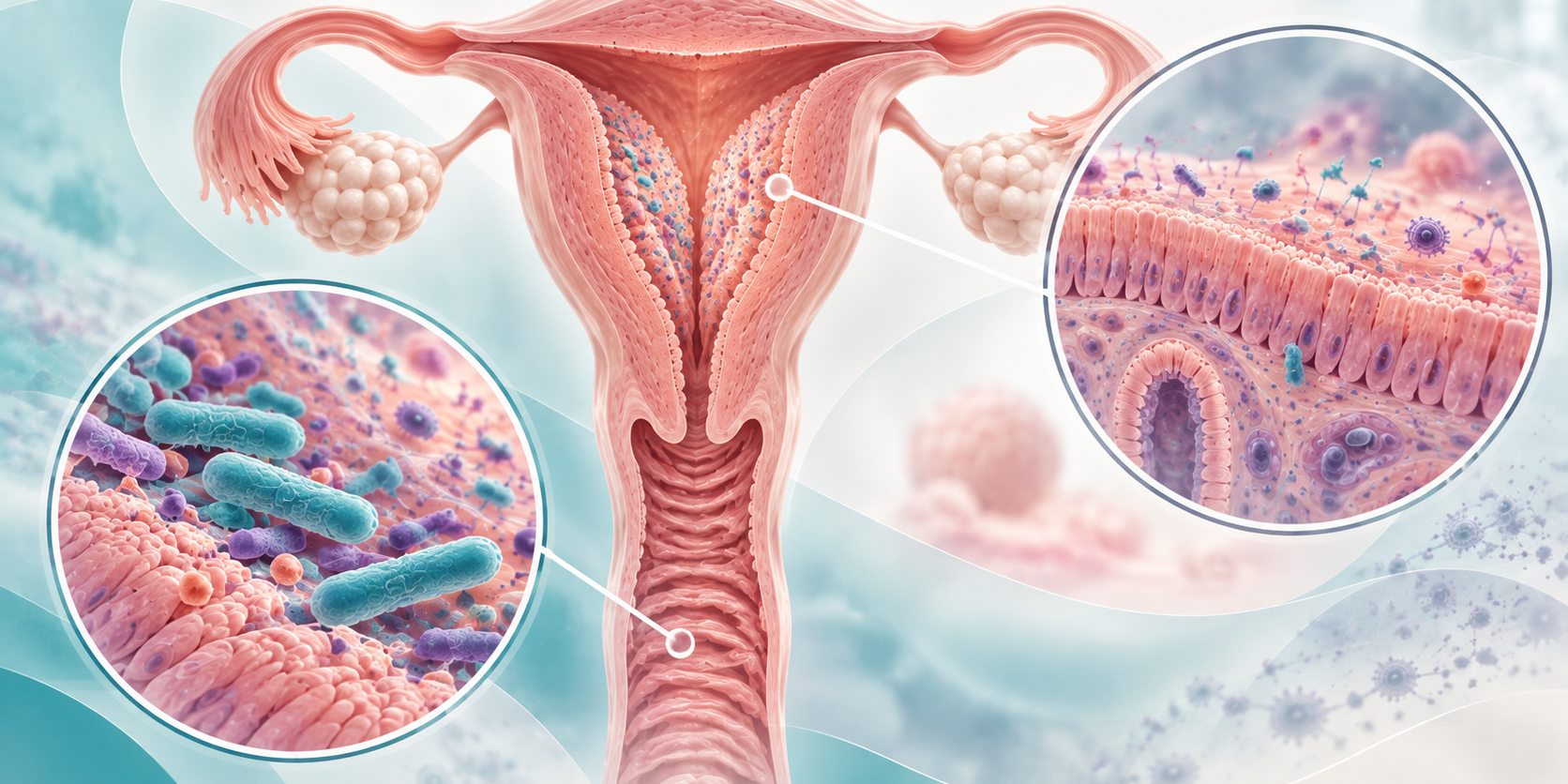
Microbiome testing is gaining attention in reproductive medicine, particularly in the investigation of infertility, embryo implantation and pregnancy outcomes. Advances in molecular sequencing have expanded our understanding of microbial communities within the female reproductive tract, generating growing interest in their potential clinical applications.
Among these communities, the vaginal microbiome is comparatively well characterized, while research into the endometrial microbiome continues to reveal important associations with reproductive outcomes.
Although these environments are anatomically connected, their microbial characteristics, sampling requirements and clinical implications are not necessarily identical.
For reproductive healthcare professionals, understanding these differences is essential when evaluating microbiome tests, interpreting results and determining how emerging scientific evidence may inform clinical decisions.
Vaginal and endometrial microbiomes: two distinct environments
The vaginal microbiome contains a relatively abundant microbial community that contributes to reproductive health.
In many reproductive-age women, this community is dominated by bacteria belonging to the genus Lactobacillus. Certain species produce lactic acid, helping maintain an acidic vaginal environment that limits the growth of some potentially harmful microorganisms [1].
However, vaginal microbial composition varies between individuals. Some women have more diverse microbial communities, and these differences do not necessarily indicate disease.
The endometrial microbiome presents a different biological and analytical context.
The endometrium, the tissue lining the uterine cavity, undergoes cyclical changes and plays a central role in embryo implantation. Molecular studies have identified microbial DNA in endometrial samples, supporting investigations into the potential relationship between the uterine microbial environment and reproductive outcomes.
Unlike the vagina, the endometrium is a low-microbial-biomass environment. Consequently, its analysis requires particular attention to sampling procedures, contamination controls and sequencing methodology [2].
These challenges do not invalidate endometrial microbiome research. Rather, they highlight the importance of rigorous analytical approaches and careful interpretation.
| Characteristic | Vaginal microbiome | Endometrial microbiome |
| Anatomical location | Vagina | Uterine lining |
| Microbial biomass | Relatively high | Very low |
| Microbial composition | Frequently Lactobacillus-dominant | Variable profiles; Lactobacillus enrichment has been associated with favorable reproductive outcomes in some studies |
| Sample collection | Vaginal swabs | Endometrial fluid or endometrial tissue aspiration |
| Main analytical considerations | Biological variability and sampling conditions | Low biomass, contamination control and analytical sensitivity |
| Current evidence | Comparatively well characterized | Growing reproductive evidence, with further clinical validation needed |
Importantly, findings from one anatomical site cannot automatically be assumed to represent the other.
Studies comparing paired vaginal and endometrial samples have identified differences in microbial composition, suggesting that vaginal sampling may not reliably characterize the endometrial environment in every patient [3].
This distinction matters when selecting tests and interpreting their results.
What does the endometrial microbiome tell us about reproductive outcomes?
One of the most promising areas of reproductive microbiome research concerns the association between endometrial microbial composition and fertility outcomes.
Several studies have investigated whether particular microbial profiles are related to embryo implantation, clinical pregnancy, miscarriage and live birth.
A prospective multicentre study involving 342 patients undergoing assisted reproduction found associations between endometrial microbial composition and reproductive outcomes. Lactobacillus was consistently enriched in patients who achieved live birth, whereas increased representation of certain other bacterial genera was associated with unsuccessful outcomes [4].
These findings support a growing body of research suggesting that characteristics of the endometrial microbial environment may be relevant to reproductive success.
Research has also explored possible associations with recurrent implantation failure (RIF) and recurrent pregnancy loss (RPL) [5,6].
Together, these findings suggest that reproductive microbial profiles may provide valuable information about the biological environment associated with implantation and pregnancy.
However, an association between a microbial profile and a reproductive outcome does not necessarily establish a causal relationship.
A particular microbial pattern may contribute to reproductive processes, reflect underlying biological conditions or be associated with other factors influencing fertility.
Similarly, identifying an unfavorable microbial profile does not automatically demonstrate that modifying it will improve pregnancy outcomes.
The scientific challenge is therefore determining which microbial findings are reproducible, biologically meaningful and clinically actionable.
Why sampling and sequencing methods matter
Interpreting microbiome results requires understanding how the data are generated.
Microbiome testing involves several stages, including sample collection, DNA extraction, amplification, sequencing, bioinformatics and interpretation.
Each stage can influence the final microbial profile.
This is particularly relevant for endometrial samples because their low microbial biomass makes them more sensitive to contamination.
During sample collection, microorganisms or microbial DNA from the vagina and cervix may be introduced into the specimen. Laboratory reagents and environmental sources can also contribute microbial DNA.
Appropriate sampling procedures, negative controls and validated analytical workflows are therefore important for distinguishing genuine biological signals from technical artifacts [2].
Sequencing methods introduce additional considerations.
Technologies such as 16S rRNA gene sequencing and shotgun metagenomics provide different levels of microbial information, each with specific capabilities and limitations.
Furthermore, detecting bacterial DNA does not necessarily demonstrate the presence of living, metabolically active microorganisms.
For reproductive healthcare professionals, these methodological details are not merely technical considerations. They influence the reliability of results and the conclusions that can reasonably be drawn from them.
How should professionals interpret reproductive microbiome tests?
As microbiome tests become increasingly visible in reproductive medicine, professionals need the knowledge required to assess their scientific and clinical relevance.
Understanding a microbiome report involves more than identifying bacterial genera or determining whether Lactobacillus is predominant.
Several questions should guide interpretation.
What does the test actually measure?
The anatomical origin of the sample, sequencing technology and analytical methodology determine what information the test can provide.
A vaginal sample should not automatically be considered representative of the endometrial environment.
How reliable are the results?
Sampling procedures, contamination controls, laboratory validation and bioinformatics methods all influence analytical reliability, particularly in low-biomass samples.
What is the clinical significance of the detected profile?
Microbial findings should be interpreted alongside the patient’s reproductive history, clinical characteristics and available scientific evidence.
The presence or relative abundance of certain bacteria does not necessarily indicate pathology or justify treatment.
Can the result inform a clinical decision?
This requires distinguishing three fundamental concepts:
- Analytical validity: whether the test reliably measures the microbial characteristics it claims to detect.
- Clinical validity: whether those characteristics are meaningfully associated with a reproductive condition or outcome.
- Clinical utility: whether using the results to guide clinical decisions improves patient care or reproductive outcomes.
This distinction is particularly important when considering emerging tests whose biological rationale is supported by observational research but whose clinical utility remains under investigation.
From microbiome research to evidence-informed reproductive care
Research into the reproductive microbiome continues to advance, supported by improvements in sequencing technologies, molecular microbiology and analytical methods.
The vaginal microbiome provides a well-established framework for understanding reproductive microbial communities, while studies of the endometrial microbiome have identified promising associations with implantation and pregnancy outcomes.
These advances are contributing to a more detailed understanding of the reproductive environment and may support future developments in personalized reproductive medicine.
However, translating microbiome research into clinical decisions requires more than access to testing technologies.
Reproductive healthcare professionals need the scientific knowledge to understand what microbiome tests measure, evaluate their methodological reliability, interpret their findings and recognize the limits of current evidence.
This expertise is essential for making informed decisions about when testing may be appropriate, how results should be communicated and whether they can support a particular clinical intervention.
As the field evolves, developing this critical understanding will become increasingly important for responsible, evidence-informed reproductive care.
Advance your knowledge with GenHERate IQ
GenHERate IQ offers the online course Reproductive Microbiome: From Science to Personalized Practice, designed for professionals seeking a deeper understanding of reproductive microbial communities, sequencing technologies, microbiome analysis and emerging clinical applications.
Through evidence-based education, the course helps professionals develop the scientific foundations and critical skills needed to evaluate microbiome testing and interpret its potential relevance to reproductive medicine.
References
- France MT, Ma B, Gajer P, et al. VALENCIA: a nearest centroid classification method for vaginal microbial communities based on composition. Microbiome. 2020;8:166. https://doi.org/10.1186/s40168-020-00934-6
- Molina NM, Sola-Leyva A, Haahr T, et al. Analysing endometrial microbiome: methodological considerations and recommendations for good practice. Human Reproduction. 2021;36(4):859–879. https://doi.org/10.1093/humrep/deab009
- Polifke A, von Schwedler A, Gulba R, et al. Differential characteristics of vaginal versus endometrial microbiota in IVF patients. Scientific Reports. 2024;14:30508. https://doi.org/10.1038/s41598-024-82466-9
- Moreno I, Garcia-Grau I, Perez-Villaroya D, et al. Endometrial microbiota composition is associated with reproductive outcome in infertile patients. Microbiome. 2022;10:1. https://doi.org/10.1186/s40168-021-01184-w
- ESHRE Working Group on Recurrent Implantation Failure. ESHRE good practice recommendations on recurrent implantation failure. Human Reproduction Open. 2023;2023(3). https://doi.org/10.1093/hropen/hoad023
- Microbiota composition of the female reproductive tract and miscarriage: a systematic review and meta-analysis. npj Biofilms and Microbiomes. 2025. https://doi.org/10.1038/s41522-025-00901-9
