
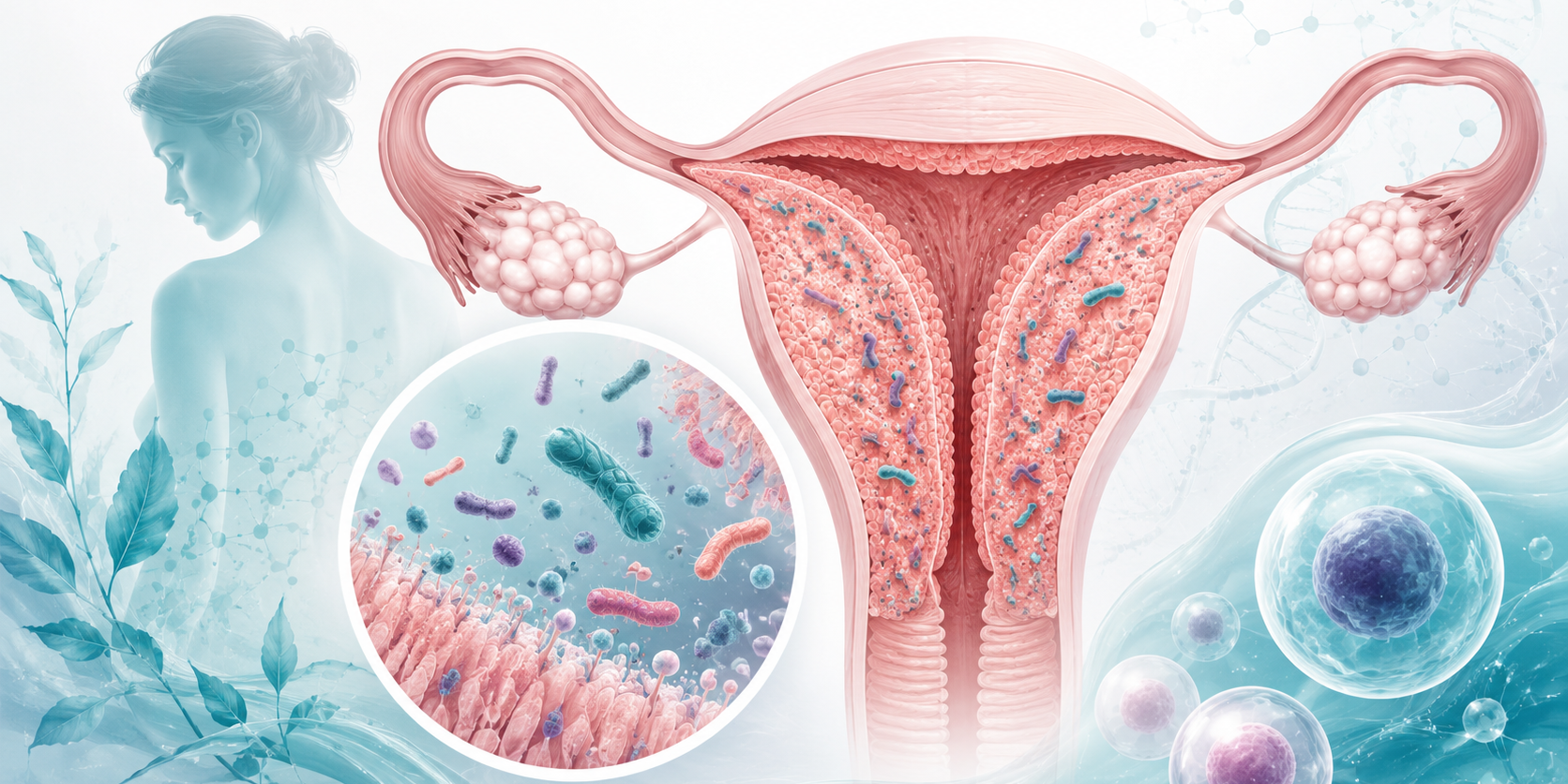
The endometrial microbiome refers to the community of microorganisms that may be present in the endometrium, the inner lining of the uterus. Although the uterus was traditionally considered a sterile environment, advances in molecular microbiology have challenged this view and opened a new field of research in reproductive medicine.
Today, the endometrial microbiome is being studied for its potential role in endometrial health, embryo implantation, recurrent implantation failure and fertility outcomes. However, this is still an evolving field. While several studies suggest that microbial composition may influence the uterine environment, there is not yet a universal definition of what constitutes a “healthy” endometrial microbiome.
Understanding the endometrial microbiome is important because implantation depends on more than embryo quality. The embryo must interact with a receptive, hormonally prepared and immunologically balanced endometrium. The local microbial environment may be one of the factors involved in this complex process.
What is the endometrial microbiome?
The endometrial microbiome is the microbial ecosystem associated with the endometrial cavity. It may include bacteria and, potentially, other microorganisms present in very low abundance.
Unlike the vaginal microbiome, which is more widely studied and usually contains a higher microbial biomass, the endometrial microbiome is considered a low-biomass environment. This means that microbial DNA is present in small quantities, making its study technically challenging.
Because of this low biomass, contamination during sampling, laboratory processing or sequencing can influence results. For this reason, studies of the endometrial microbiome require careful methodology, strict contamination controls and cautious interpretation.
Is the uterus sterile?
For many years, the uterus was believed to be sterile in healthy women. This idea was based largely on traditional culture methods, which often failed to detect microorganisms in the upper reproductive tract.
More recent molecular techniques, including 16S rRNA sequencing and next-generation sequencing, have suggested that microbial communities may be detectable in the endometrium. These findings have changed the way researchers think about the uterine environment.
However, the presence of microbial DNA does not always mean that live, active bacteria are present. It also does not automatically mean disease. The clinical significance of many findings remains under investigation.
In reproductive medicine, the key question is not only whether microorganisms are present, but whether certain microbial profiles are associated with better or worse reproductive outcomes.
Why does the endometrial microbiome matter in reproductive medicine?
Reproductive success depends on a coordinated interaction between the embryo and the endometrium. This interaction involves hormonal regulation, immune signaling, tissue remodeling, vascular changes and molecular communication.
The endometrial microbiome may matter because microorganisms can influence local inflammation, immune balance and epithelial function. A balanced microbial environment could help maintain endometrial homeostasis, while dysbiosis may be associated with inflammation or impaired receptivity.
Some studies have linked altered endometrial microbial profiles with infertility, recurrent implantation failure and recurrent pregnancy loss. Still, the evidence is not definitive, and more robust studies are needed before microbiome-based diagnosis or treatment can be applied routinely.
Endometrial microbiome and implantation
Embryo implantation is one of the most complex steps in human reproduction. It requires a competent embryo, a receptive endometrium and precise timing during the window of implantation.
The endometrial microbiome may influence implantation through several possible mechanisms:
- modulation of local immune responses
- regulation of inflammatory signals
- interaction with epithelial and stromal cells
- influence on endometrial receptivity
- association with chronic endometritis
- potential effects on embryo-endometrium communication
A microbiome dominated by beneficial or non-inflammatory microbial communities may support a healthier uterine environment. In contrast, dysbiosis, meaning an imbalance in microbial composition, may contribute to inflammation or altered receptivity.
However, it is important to be precise: the endometrial microbiome is not the only determinant of implantation. Embryo chromosomal status, uterine anatomy, hormonal environment, endometrial thickness, progesterone exposure, immune factors and transfer conditions also play major roles.
Lactobacillus and the endometrial environment
In the vaginal microbiome, Lactobacillus species are often considered beneficial because they help maintain a low-pH environment and limit the growth of potentially pathogenic bacteria.
In the endometrium, the role of Lactobacillus is more complex and still debated. Some studies have suggested that a Lactobacillus-dominant endometrial profile may be associated with better reproductive outcomes, while non-Lactobacillus-dominant profiles may be more frequently observed in patients with implantation failure.
Nevertheless, this does not mean that every endometrial sample must be Lactobacillus-dominant to be considered healthy. Different studies use different sampling methods, sequencing technologies and thresholds, which makes direct comparison difficult.
For this reason, Lactobacillus dominance should be interpreted as a research signal, not as a universal clinical rule.
What is endometrial dysbiosis?
Endometrial dysbiosis refers to an imbalance in the microbial composition of the endometrium. This may involve reduced Lactobacillus abundance, increased diversity or the presence of potentially pathogenic bacteria.
Potentially relevant bacteria described in reproductive microbiome studies include genera such as Gardnerella, Atopobium, Prevotella, Streptococcus, Escherichia-Shigella and others. Their relevance depends on abundance, clinical context and whether inflammation is also present.
Dysbiosis may be associated with local inflammatory changes, altered cytokine signaling and disruption of endometrial receptivity. However, association does not always prove causation. More research is needed to determine whether dysbiosis directly causes implantation failure or whether it reflects another underlying condition.
Endometrial microbiome and chronic endometritis
Chronic endometritis is a persistent inflammation of the endometrial lining. It is often subtle and may be asymptomatic, but it has been associated with infertility, recurrent implantation failure and recurrent pregnancy loss.
The condition is usually diagnosed by endometrial biopsy and histological assessment, often with immunohistochemical detection of plasma cells.
The endometrial microbiome may be relevant in chronic endometritis because microbial imbalance could contribute to persistent inflammation. Conversely, inflammation itself may modify the local microbial environment.
This relationship is one of the reasons why microbiome research is gaining attention in reproductive medicine. Still, chronic endometritis and endometrial dysbiosis are not identical concepts. A patient may have microbial alterations without confirmed chronic endometritis, or chronic inflammation with complex microbial findings.
Can the endometrial microbiome affect fertility?
The endometrial microbiome may affect fertility indirectly by influencing the uterine environment. A favorable endometrial environment supports embryo-endometrium communication, immune tolerance and implantation. An unfavorable environment may interfere with these processes.
Research suggests possible links between endometrial microbiome alterations and:
- infertility
- recurrent implantation failure
- recurrent pregnancy loss
- chronic endometritis
- altered endometrial receptivity
- poor outcomes in assisted reproduction
However, the clinical interpretation remains cautious. Current evidence is promising but heterogeneous. Differences in patient selection, sample collection, sequencing techniques and outcome definitions make it difficult to establish universal conclusions.
In clinical practice, microbiome information should be considered as part of a broader reproductive assessment, not as an isolated explanation for infertility.
How is the endometrial microbiome studied?
The endometrial microbiome is usually studied using molecular techniques. These methods can detect microbial DNA even when microorganisms are difficult to grow in culture.
Common approaches include:
- 16S rRNA sequencing
- next-generation sequencing
- quantitative PCR
- metagenomic analysis
- endometrial biopsy or catheter-based sampling
Each method has advantages and limitations. Because the endometrium contains low microbial biomass, sampling technique is particularly important. Contamination from the vagina, cervix, instruments or laboratory reagents can affect results.
For this reason, researchers increasingly emphasize the need for standardized sampling protocols and contamination controls.
Can the endometrial microbiome be tested clinically?
Some commercial tests aim to assess the endometrial microbiome in patients undergoing fertility treatment, especially those with recurrent implantation failure or repeated pregnancy loss.
These tests may identify microbial profiles, Lactobacillus abundance or potentially pathogenic bacteria. In some cases, clinicians may use the results to guide antibiotic or probiotic strategies.
However, routine use of endometrial microbiome testing remains debated. There is not yet enough high-quality evidence to recommend universal testing for all patients undergoing IVF.
Testing may be considered in selected clinical contexts, particularly when there is recurrent implantation failure, suspected chronic endometritis or unexplained reproductive failure. Even then, results should be interpreted carefully by specialists.
Can the endometrial microbiome be modified?
The endometrial microbiome may potentially be modified through targeted treatment, but this area is still under investigation.
Possible approaches include:
- antibiotics when a specific infection or chronic endometritis is confirmed
- probiotics in selected contexts
- treatment of vaginal dysbiosis
- management of inflammation
- optimization of reproductive and hormonal conditions
However, self-treatment is not recommended. Antibiotics and probiotics should not be used indiscriminately because they may alter microbial balance and may not address the actual cause of implantation failure.
Future studies may clarify which patients benefit from microbiome-guided interventions and which protocols are most effective.
Endometrial microbiome and IVF
In IVF, the endometrial microbiome is of particular interest because embryo transfer provides a defined clinical moment to study implantation.
Some studies have explored whether endometrial microbial profiles are associated with pregnancy rates, implantation rates or live birth outcomes. Others have investigated whether patients with recurrent implantation failure show different microbial patterns compared with controls.
Although findings are not fully consistent, the research supports an important idea: the uterine environment matters.
In assisted reproduction, improving outcomes may require looking beyond embryo morphology and considering the endometrium as an active, dynamic and biologically complex tissue.
Why this field is still evolving
The endometrial microbiome is a promising but technically complex area of research.
Several challenges remain:
- the endometrium has very low microbial biomass
- contamination can influence results
- studies use different sampling methods
- definitions of “normal” and “abnormal” microbiome vary
- patient populations are heterogeneous
- causality is difficult to prove
- intervention studies are still limited
For these reasons, the endometrial microbiome should be approached with scientific rigor. It is not a simple diagnostic marker, but a developing field that may help refine our understanding of fertility and implantation.
Future perspectives in fertility research
Future research may help determine how the endometrial microbiome interacts with endometrial receptivity, immune function, inflammation and embryo implantation.
Multi-omics technologies, including genomics, transcriptomics, metabolomics and microbiome analysis, may provide a more complete view of the uterine environment. This could support more personalized approaches in reproductive medicine.
For professionals in fertility care, understanding the endometrial microbiome may become increasingly relevant as the field moves toward precision reproductive medicine.
Understanding the Endometrial Microbiome: From Research to Clinical Practice
As endometrial microbiome research advances, reproductive healthcare professionals need the scientific knowledge to critically evaluate microbiome testing, understand sequencing methodologies and interpret results within the context of current clinical evidence.
GenHERate IQ offers the online course Reproductive Microbiome: From Science to Personalized Practice, designed for professionals interested in exploring reproductive microbial communities, microbiome analysis, sequencing technologies and emerging applications in reproductive medicine.
Through evidence-based education, the course helps professionals develop the skills needed to understand the potential clinical relevance of microbiome findings while recognizing the limitations of current evidence.
Key takeaways
The endometrial microbiome refers to the microbial community associated with the endometrium. It is a low-biomass environment and requires careful scientific analysis.
Research suggests that the endometrial microbiome may be related to fertility, implantation, chronic endometritis and recurrent implantation failure. However, the evidence is still evolving, and results must be interpreted cautiously.
A healthy reproductive outcome depends on many interacting factors, including embryo quality, endometrial receptivity, hormonal timing, immune balance and uterine health. The endometrial microbiome may be one important piece of this larger biological puzzle.
For reproductive medicine, this field offers a promising opportunity to better understand the uterine environment and improve evidence-based fertility care.
References
- Moreno I, Codoñer FM, Vilella F, et al. Evidence that the endometrial microbiota has an effect on implantation success or failure. American Journal of Obstetrics and Gynecology. 2016;215(6):684-703.
- Karadbhajne P, More A, Dzoagbe HY. The role of endometrial microbiota in fertility and reproductive health: a narrative review. Cureus. 2025.
- Zhang H, Zou H, Zhang C, Zhang S. Chronic endometritis and the endometrial microbiota: implications for reproductive success in patients with recurrent implantation failure. Annals of Clinical Microbiology and Antimicrobials. 2024.
- Clinical Relevance of Vaginal and Endometrial Microbiome Investigation in Women with Repeated Implantation Failure and Recurrent Pregnancy Loss. International Journal of Molecular Sciences. 2024.
- The Endometrial Microbiota’s Role in Fertility: Updates and Future Directions. Current Obstetrics and Gynecology Reports. 2024.
